
Two Leaders--Two Legacies
One of the most fascinating stories of how leaders are shaped comes to us from the 18th century. The story involves two leaders, an ocean apart, who never met, yet whose lives and purpose in life paralleled each other’s in an amazing way. Both men would gain worldwide fame in their day, though today we hardly know the one while we lionize the other man every year. Here is a lesson for today’s current and emerging leaders--if we have ears to hear.Common Beginnings
They were born but 16 years apart, one in America one in England, and their entire professional lives were profoundly affected by the century’s ferment of revolution in America and Europe. Both came from well-to-do families, descended from prominent and well-respected lineage. Each lost his father at an early age and then each came under the influence of strong male role model and mentor whom they would later say profoundly impacted their life direction. A first rate education for the day was also a common experience—one attended William and Mary while the other was a Cambridge man. Interestingly, they would choose the same profession as young men—politics—and were viewed as rising prodigies, possibly destined for the very top of their profession. They each showed great courage early on by introducing unsuccessful bills to abolish slavery in America and England, respectively. They saw their bills summarily rejected by the political leaders as threatening the very lifeblood of their economies, which became for them early lessons in the difficulty of societal change.Uncommon Endings
One man eventually fulfilled the early promise and headed his government, while the other remained in the legislature for 40 years, never progressing. Over the course of their lives, both men (to use today’s terminology) were respected--even honored--change leaders, profoundly altering the course of their countries; yet, both would die with no financial resources. So which would be judged by history as the more successful leader? The one who became President or the one who “languished” in Parliament? This is not a simple question to answer.For on the other side of the ledger, only one persisted in his commitment to abolish slavery and would live to see its legislated end come peacefully two days before he died. The other, before he died, inexplicably worked to extend slavery, belying his often-voiced principles. Then forty years after his death a terrible civil war was fought to end slavery once and for all, taking the lives of over six hundred thousand men.
The only logical question is “why?” Why did Thomas Jefferson who became both the American President and revered elder statesman never fulfill his avowed purpose and beliefs to take any real action toward abolition, even declining to associate with the abolitionist movement in his post-Presidency years? And why did William Wilberforce expend his energy, health, reputation and opportunity for great office in order to see first the slave trade and then slavery itself ended by peaceful means in England and its colonies? It is a complex question, but a good part of the answer lies in how they were shaped as leaders by their mentors. At least it is the place to begin to understand.1
Early Mentors
Jefferson said unequivocally that William Smalls was the person who “fixed the destiny of my life.” Smalls was a Scottish professor of mathematics and philosophy at William and Mary and also the most prominent Enlightenment (rationalism) scholar in America. He took young Jefferson under his wing, and together with Governor Fauquier and the attorney George Wythe they made a regular foursome discussing a wide range of subjects over frequent meals together. More than anyone, Smalls shaped Jefferson’s worldview—the way he saw and interpreted the world and his role in it. For his entire life, the only way that he saw progress was through the expanding mind of man as the world opened up to a plethora new scientific discoveries, which the Enlightenment viewed as inexorably leading to the improvement of the lot of all mankind. In short, it was an optimistic view with a great faith in the future solution of all societal ills, controlled by the people and their leaders. Destiny lay in the hands of the people, not in some outside force.Wilberforce, on the other hand, came under the influence not of a scholar but of a dynamic sea captain whose stories and powerful life deeply impacted him at the age of ten and again later when he entered Parliament. John Newton was a close friend of the aunt and uncle with whom young William lived for a time after his father’s death. For years, Newton had captained a ship that hauled captive slaves—he was a “slaver”—until a dramatic change in his life came during a tremendous storm where he vowed to God he would never haul slaves again if he lived. Today if we know John Newton at all, we know him for his ubiquitous hymn, Amazing Grace. Newton, childless, considered William almost as his own son. His vivid tales of the horrors of the slaves in the hold of the ship (often a large percentage arrived dead at the port, the conditions were so appalling) implanted themselves in William’s young mind, as did Newton’s contagious faith and heartfelt tears of shame. Like Newton, Wilberforce would not place his life and destiny in his own hands, alone.
Wilberforce would later drift into the heady life of a wealthy young bachelor about town, but the endless round of social engagements left him empty and in his mid-twenties he came back to the faith of his youth. At that point, he had a key seat in Parliament but thought that if he was a man of true faith the only course was the ministry. Quietly he met with John Newton, and the old man’s counsel was telling—stay in Parliament, this is your calling in life.
Two Great Objects
Shortly thereafter, Wilberforce committed his life to “two great objects:” the abolition of slavery and the reformation of manners and morals in all of England. He did not veer from that focus for the remaining forty years of his life. It cost him the likely opportunity to become Prime Minister, and made him (for a time) the enemy of many of the most prominent leaders of the era. He was beaten up twice, and the stress of his efforts broke his health for a time.In contrast to the rising popularity of rationalism, Wilberforce’s worldview considered black slaves to be men created equally, not property as Jefferson would argue state constitutions held. For despite the memorable words in the Declaration of Independence, Jefferson believed the Federal government should have no Constitutional role in regulating slavery—that was the province of each state.
Wilberforce also viewed the prevailing selfishness of English society as the root of inaction on a variety of social ills, and over the course of a career he “made it fashionable to do good.” His worldview held that knowledge of societal ills must lead to action if the betterment of people and society was to occur. Widely considered the best orator of his era, Wilberfoce used a mix of legislation, oral and written persuasion, personal example, and his own wealth to improve working conditions for children and women, assist the poor, improve literacy, and even promote the proper treatment of animals (he started the first SPCA). From his efforts emerged the society that ushered in the Victorian era—the high water mark of England.
Rise to Power
Jefferson, meanwhile, created a new political movement and what became a second party as his impassioned views against Federalism began to prevail in America. Jefferson saw society as best improved by removing all forms of tyranny, be it the over zealous legislation of a central government seen in the first twelve years of the new nation, or the central role of the state supported church. These were central themes throughout his life.Washington, Hamilton and Adams, as the chief proponents of the need for strength in the government came in for journalistic vilification, which Jefferson helped to support. It led him to the Presidency in what he called “the second American revolution.”
The expansion west, and later the University of Virginia were to be his most telling accomplishments first as President and then as revered elder statesman whose role in the Revolution and its written expression gave him a unique place of honor. But even as America expanded west, so did slavery--with Jefferson’s approval of the compromises that entailed. He knew that in slavery we had “the wolf by the ears” as he expressed it, but he left it to the next generation and each state to solve. The legacy of our Civil War must, in part, be his to share.
Lessons
Both Smalls and Newton shaped the destinies, not only of Jefferson and Wilberforce, but of England and America as well. Their place is perhaps little appreciated by us today, but clearly if we understand how leaders are grown, the role of a good mentor cannot be overstated. But more than a shaping role of a mentor, we need to appreciate the power of beliefs in sustaining a purposeful commitment. In The Fifth Discipline, Peter Senge has shown that in order to understand a person we need to get beyond what they express to dig deeper to understand what they really believe.It was the beliefs of William Smalls and John Newton from which the worldview of Jefferson and Wilberforce emerged and influenced what they did and why.2 For those in public service, a reexamination of the beliefs that lie behind our unique form of government coming out of the 18th Century would be an exercise well worth undertaking. The power of beliefs in a mentor or a leader cannot be overestimated.
1. For a fuller treatment of this question, see the three-part article "Wilberforce and Jefferson: Leaders Who Changed Their Times."
2. For those wanting to understand both of these leaders more fully, two excellent books will be helpful: For Wilberforce, Kevin Belmonte, A Hero for Humanity, (Navpress: Colorado Springs, 2002). For Jefferson, Joseph Ellis, American Sphinx: The Character of Thomas Jefferson, (Knopf: New York, 1997)
©2006 GovLeaders.org
Related Articles
- Leaders and Stories
By Ray Blunt - The 3Cs of Developing Leaders
By Ray Blunt - On a Mission
By Ray Blunt - Growing Leaders of Character
Q&A with Gene Klann, author of the book Building Character
Books by Ray Blunt
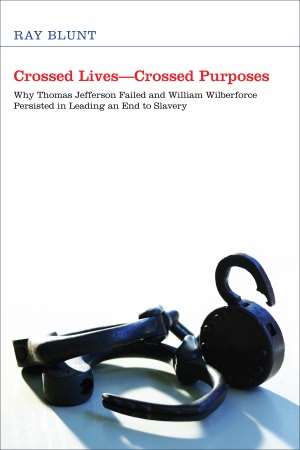
Crossed Lives--Crossed Purposes
Ray Blunt beautifully weaves together the lives of two of
history's great men--William Wilberforce and Thomas Jefferson--and in doing so reveals compelling new insights about the importance of a leader's world view and how mentors influence that world view.
This inspiring and thought-provoking story also teaches us much about the
importance of a clear life mission and how a leader's allies can help him
accomplish that mission.
Read More...