
Learning to Lead, Part I
The following article was originally published in The Marine Corps Gazette in January 1997. Reprinted with the kind permission of the author.
Successful leaders don't need rows of sharp teeth to swim with the sharks. Here are 30 common sense, often-forgotten tips for good leadership.
In speaking to large audiences on leadership, I am often asked to do the impossible. In less than an hour's time, I am expected to motivate them to improve their skills, inspire them to be better leaders, and to acquaint them with the new technologies and concepts.
To cover all these points in the time allotted, I have come up with "30 Blazing Flashes Of The Obvious" about leadership. Here they are:
1. Know Yourself
All leaders should realize they are, in fact, five or more people. They are who they are, and who they think they are, (and these are never the same); they are who their bosses think they are; and who their subordinates think they are.
Leaders who work hard to get feedback from many sources are more likely to understand and control their various selves, and hence be better leaders.
2. Develop Mental Toughness
Leaders must be brutally honest with themselves or they will slip into
the terrible habit of self-deception. Even the best leaders make mistakes.
By smoking out these mistakes and correcting them quickly, a good leader
can become a superb one.
3. Be Magnanimous
Leaders who share their power and their time can accomplish
extraordinary things. The best leaders understand that leadership is the
liberation of talent; hence they gain power not only by constantly giving
it away, but also by not grabbing it back.
4. Squint With Your Ears
The most important skill for leaders is listening. Introverts have a great
edge, since they tend to listen quietly and usually don't suffer from
being an "interruptaholic." Leaders should "squint with their ears." Too
many bosses are thinking about what they will say next, rather than
hearing what is being said now.
5. Trust Your Instinct and Your Impulse
If something smells bad, sounds funny, or causes you to lose sleep at
night, take another look. Your instincts combined with your experience can
prevent you and your organization from walking off the cliff.
6. Learn By Failure
In my professional career, I have learned much more from my failures than
from my successes. As a result, I have become tolerant of the honest
failure of others. When a major setback comes along, try to treat it as a
marvelous learning experience, for most certainly it will be just that.
7. Protect Innovators
For three years I had a Medal of Honor recipient from Vietnam, Army Col. Jack
Jacobs, working for me. He is by far the most innovative person I have
ever known. Well over 50 percent of his ideas were awful, but buried among
these bad ideas was an occasional pearl of great wisdom. I learned that I
had to protect Jack and my organization from his bad ideas while
encouraging him to present all his ideas, so we could use his great ones.
8. Beware of Certainty
Leaders should be a bit skeptical of anyone who is totally certain about
his or her position. All leaders should have a decent doubt especially
when dealing with "true believers" who are always sure they are right.
9. Be Decisive
Top leaders usually must make prudent decisions when they only have about
60 percent of the information they need. Leaders who demand nearly all the
information are usually months or years late making decisions.
10. Don't Become Indispensable
Organizations need indispensable institutions not indispensable people.
Leaders should not allow themselves to become indispensable, nor should
they let any of their subordinates do so.
11. Avoid the Cowardice of Silence
During meetings, so-called leaders often sit on their hands when it is
time to raise a hand and speak up. Leadership requires courage - courage
to make waves, courage to take on our bosses when they are wrong, and the
courage of conviction. Every Robert E. Lee needs a James Longstreet to
tell him exactly the way it is.
12. Fight Against Paranoia
Welcome criticism, help people understand that it is OK to have "love
quarrels" with the organization. Loyalty and criticism are mutually
supporting while slavish loyalty is deadly. Avoid the defensive crouch.
Never attribute to malice that which is adequately explained by stupidity.
13. Be Goal Oriented
Leaders, even at a lower level, must try to set some long-term goals for
their people and for their organization. People want to know where they
are going and in what order of priority.
14. Follow the Platinum Rule
The golden rule is marvelous. But in leadership situations, the platinum
rule may be even better: "Treat others the way they would like to be
treated."
15. Don't Waste People's Time
The best question a leader can ask a subordinate during a counseling
session is, "How am I wasting your time?" Not everyone will tell you, but
cherish the ones that do, for they will help you grow and prosper as a
leader.
16. Thank the Invisible People
There are lots of fine people doing great work who seldom get thanks
because they are "invisible." They work so quietly and so competently that
they often are not noticed by the leader.
17. Don't Send Out "I Don't Trust You" Messages
People who say "I never want to be surprised" or "Check with me before you
start anything," or "I'm off on a trip; I will call in every morning for
an update" are sending out very strong "I don't trust you" messages to
their subordinates. People who know they are not trusted will never
contribute at their full potential.
18. Serve, Don't Humor the Boss
Too many leaders see their big tasks as keeping their bosses happy,
getting to the bottom of the in-box, or staying out of trouble. That is
not what leadership is all about. Leadership is serving the mission and
serving your people.
19. Criticize Up, Praise Down
Leaders must deflect at least some of the bad guidance they get from
above. Is it being loyal to your boss and to the institution you serve to
tell the bosses when they are wearing no clothes?
20. Be Physically Fit
Everyone has a "health age." If you exercise regularly and watch your
diet, you can make yourself four or five years younger than your
chronological age.
21. Develop Solid Leadership Skills
The best leaders in business, the nonprofit sector, and government are
superb at time management and are competent in speed reading, personal
computers, dictation skills, and the use of manual and electronic
brainstorming techniques.
22. Help Your People Understand You
When you take over a new organization, get your key people together and
tell them what your top priorities and your pet peeves are. It is
especially important for them to learn very early what really bugs you.
They will appreciate your candor.
23. Smoke Out Those of Low Integrity
Leaders must sniff the air constantly to ensure high standards of ethics
are maintained. In almost all large organizations, someone is walking out
the back door with something. Expense accounts, personnel records,
training reports, and contracts need regular scrutiny.
24. Concentrate on Performance, Not Just Results
How you get results is important. Leaders who don't concern themselves
about the process and the performance that leads to the results are making
a big mistake. Always ask yourself what it took to gain those great
results.
25. Maintain a Sense of Outrage
There are many super-cool managers who worry too much about keeping their
bosses happy. As a result, they never allow themselves to be outraged when
the system is doing serious damage to those who work for them. The best
leaders get mad occasionally and, using controlled outrage, can often make
right wrongs that are levied upon their people.
26. Beware of Intimidation
Be very careful here. Some bosses allow themselves to be intimidated by
outsiders, by their bosses, and even by their subordinates. An intimidated
boss can never be a great leader. You have to have an independent mind to
make the right choices.
27. Avoid the Activity Trap
Don't confuse being busy with being productive. Without discipline,
managers can become slaves to their meetings, travel schedules, in-boxes,
and telephones. They get so wrapped up in the minutiae that they can
become "in-box managers" rather than visionary leaders.
28. Build a Robust Braintrust
One of the great secrets of success is to have a braintrust of experts on
various issues. I have learned that a braintrust of around 300 real smart
and quick thinking friends can be very helpful whenever I need help. I
have their office and home phone numbers and their e-mail addresses so I
can get hold of them quickly. The braintrust is reciprocal in that we help
each other.
29. Beware of the Paul Principle
Too many leaders allow themselves to slowly slide downhill in competence.
When they lose touch with the issues, the new technologies, and the
people, they have fallen victim to what I call the Paul Principle.
The future is coming fast. Leaders need to think about the future and prepare their people for it. To keep a close eye on the future, join the World Future Society and read two magazines regularly - Business Week and The Futurist.
30. Get Ready for the Future
Soon leaders will have exciting new technologies to help them be more
efficient and effective leaders. The automatic dictating machine will
allow leaders to quickly answer their daily mail or write their memos or
weekly column. Teleconferencing will reduce the need for travel and speed
up consensus-building and decision-making.
Electronic brainstorming will accelerate the velocity of innovation. Electronic mail will reduce time wasted with "telephone tag."
All leaders must work hard to build the future, for that is where they and their people will spend the rest of their lives.
A retired major general, Perry M. Smith served for 30 years in the U.
S. Air Force. During his career he had a number of leadership experiences,
including command of the F-15 wing at Bitburg, Germany where he provided
leadership to 4000 personnel. Later, he served as the top Air Force
planner and as the Commandant of the National War College, where he taught
courses on leadership of large organizations and on strategic planning.
He is the author of the book Rules and Tools
for Leaders and is currently the President of Visionary Leadership
in Augusta, Georgia.
The Marine Corps Gazette ©1997.
More by MagGen Perry Smith
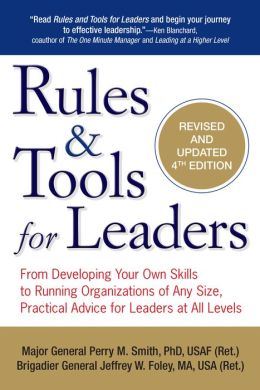
Rules & Tools for Leaders: A Down-to-Earth Guide to Effective Managing
Related Articles
- Quotations from Chairman Powell: A Leadersip Primer
By Oren Harari - Doing a Job (Adm. Hyman Rickover)
Excerpt from a speech by Adm. Hyman Rickover