
Most leadership advice floats uselessly on the surface. We are bombarded with slogans like "the foundation of leadership is trust" or "we have a high-performance culture." These statements aren't wrong; they are just stuck at a platitudinous level. Telling a manager to "build trust" is like telling a golfer to "hit it straight." It names the destination but completely fails to provide the road to get there.
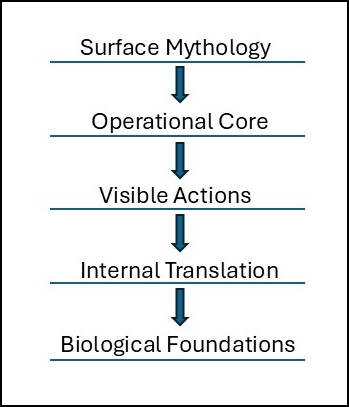
To drive true innovation and human performance, we must look past the slogans and move down through the functional layers of human nature—from organizational mythology down to hard biology.
Layer 1: Surface Mythology (Fables & Platitudes)
This is the superficial tier where most traditional leadership advice stalls out. It consists of memorable moral narratives—such as Aesop’s fable of the sun warming a traveler to remove his coat voluntarily rather than the wind forcing it off—and generic corporate maxims like "communication is key." While directionally valid, this layer is functionally incomplete. No executive can walk into a high-stakes meeting, tell a silent, pressured team to "be the sun," and expect turnaround performance. Platitudes describe an ideal destination; they provide no roadmap. LinkedIn offers a lot of this as do inspirational speakers.
Layer 2: Operational Core (Principles)
This layer looks directly beneath the myth to identify the causal operating truths. At this level, abstract concepts are translated into clear cause-and-effect rules. For example, the platitude of "trust" is engineered down to a functional core principle: People trust leaders when they repeatedly experience safety, fairness, honesty, and follow-through from someone who holds systemic power over them. Leadership is no longer viewed as a vague, charisma-based aspiration; it becomes the predictable result of a repeated, structural pattern. This level is taught in many leadership courses.
Layer 3: Visible Actions (Behaviors & Practices)
This layer is where leadership manifests tangibly across the organization. Practices are the repeatable structural mechanisms—such as weekly check-ins, standardized whiteboard questions, and full-inclusion exercises—that ensure effective management isn't dependent on an executive's fleeting mood or personality. These practices systematically dictate a leader's actual, observable behaviors: listening without interrupting, asking clarifying prompts before giving directives, and refusing to penalize bad news. Employees do not experience an organization's values statement; they experience it through the boss’s behaviors.
Layer 4: Internal Translation (Perceptions & Cognitive States)
Leadership never happens because of a manager's intention; it happens entirely in the employee's interpretation. A leader's physical behavior triggers an employee's immediate perception. If an executive believes they are "communicating urgency," the team may perceive that "leadership is panicking." This internal translation immediately locks the employee into a distinct cognitive state. They either enter an engaged state of available energy and ownership ("It is safe to contribute here"), or a disengaged state of withheld energy and defensive self-protection ("Why bother? Speaking up carries too much risk"). Workplace disengagement as measured by Gallup and others, is rarely an attitude problem; it is a defensive cognitive state engineered by repeated experiences of management’s daily behaviors.
Layer 5: Biological Foundations (Psychology & Biochemistry)
At the deepest foundational level, leadership behavior ceases to be a social event and becomes a hard biological event inside another human being. Evolutionary psychological mechanisms—like loss aversion (the fear of losing status) and social pain (the neural damage caused by isolation)—trigger an immediate body-brain response. Threat, uncertainty, and perceived unfairness flood the nervous system with stress hormones, narrowing attention and forcing the brain into protection mode. Conversely, psychological safety and recognition trigger an optimal internal biochemistry that opens up cognitive bandwidth, intrinsic motivation, and collaborative creativity. The leader literally changes the employee’s internal operating condition, dictating exactly how much intelligence and effort they bring to the enterprise. In general, all aspects of performance management produce stress chemicals.
Conclusion: Transforming Slogans into Science
Ultimately, exceptional leadership is not about mastering clichés, but about mastering human nature. When an executive understands that a single behavioral choice triggers an immediate biological cascade inside an employee, management shifts from an unpredictable art to a reliable, human-centric science. By intentionally guiding your team down through these five layers—from surface expectations to the deepest biological foundations—you stop demanding performance and start scientifically engineering the precise environmental conditions that make high-level innovation and performance inevitable.
© Mike Mears 2026. Used with the author's kind permission.