
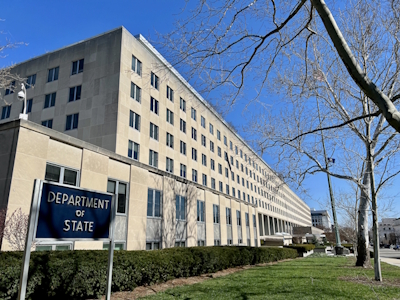
As a senior leader at the U.S. Department of State, Roland F. de Marcellus regularly shared the following document with his teams in an effort to be clear and up-front about his leadership philosphy and expectations.
Roland's Rules
My basic rule is to attract staff that is more intelligent and capable than I am and then get out of the way. Looking around, I think I have succeeded.
The thoughts below are not new. I think I have discussed these ideas with most of you (in some cases for many years), but I thought it would be good to capture it on paper.
Impact: We all come to government and to the State Department because we want to have an impact for the good of the American people and ideally the world’s people. We also owe it to the American people who pay our salaries that we have an impact. We should be able to relate this impact to something tangible on the ground, ideally with a $ sign next to it. Our division has had incredible impact in recent years with concrete results. None of these were my ideas. All came bottom up. If we have a job position that is not having impact for the American people, let’s revisit the job position.
Judgment and interpersonal skills: These are the main two qualities I look for. The rest we can teach. Interpersonal skills also mean team players who make our division a fun place to work in which everyone helps each other and enjoys their office interactions. This has been a “no jerk zone” for years. Careful scrutiny of references keeps it that way.
EMPOWERMENT: This is in all caps because I think it is so important and usually an area for improvement. I hire for judgment and interpersonal skills also because they are essential if we are to empower people. Our division’s issues are special. They often involve large sums of money and are highly technical. Our desk officers are State’s experts on these issues. As the experts, I want our desk officers to be able to engage directly at the Deputy Assistant Secretary level in regional bureaus and make the fact-based arguments that can change a regional bureau position (as I write this, we had another example this week). Please keep your chain of command informed. I also want our desk officers in the room with the Secretary and other Department leaders on their issues whenever possible. That has served us well in the past as desk officers with expertise prevented misperceptions of issues from taking senior flight. My proudest moments are when our desk officers have outsized impact (many great examples). Empowerment also gets staff promoted.
Expecting mistakes: Empowering junior staff increases the risk of mistakes (which is why risk-averse State falls short on empowerment). I accept this risk and expect mistakes along the way. I also expect honesty after a mistake. Own up right away with all the details so we can clean up together. And please limit repeats of the same mistake. I make mistakes too and also own up (as I write this, another example this week).
Not looking for “yes people:” When I clear a paper, I generally call my edits “suggestions.” Please push back if you disagree. You are the experts, and we hired you for your brains.
Honest, Collaborative, Transparent: This is how we make policy in the Department and interagency. We are always honest with our interlocutors. Collaborative means including those with different policy views from the beginning of the process or very close to it. Even if you think an office will disagree with your paper, clear with them and argue it out openly and early. Remember that “substance is important, but process is personal.” Policy-making is difficult enough without making enemies via bad process who can later delay or block your efforts. They will also remember years later. And while their mandate and perspective may be different, it is legitimate. Try to find a good solution. Attack the problem, not the people. That said, we have our views on what is the best policy from our perspective. Be transparent and open about how you see it. We are collegial, but not push-overs. Make the best fact-based case and ask for push-back. Work constructively. If you can’t resolve, amicably elevate as needed to whatever level is needed to resolve it. If you win, no victory dances in the end zone. Policy-making is a repeated game exercise. If you build relationships of trust from the above approach, you will be amazed at how fast you can make policy in later iterations. You will also be viewed as an honest broker whom people want to lead processes. That has often given our division outsized influence and impact.
Leaders have only two priorities: Accomplish the mission and take care of your people. Period. That is the full list for leaders who are professionals. I view your promotions, follow-on assignments, awards, new career opportunities, etc., as my priorities as they fall under me taking care of my people. “Careerists” are supervisors who focus on themselves and their own careers first, with a constant eye to advancing to their next position. We don’t have careerists in our division.
Respect: ALL staff should respect the dignity of ALL those they encounter at ALL times. Our division should be a welcoming workplace that leverages the full contributions of everyone for the greatest productivity and impact. This falls under the rubric of basic good management.
Work-life balance: Or, as I like to call it, “Balancing work ambition with life ambition.” Our division should offer interesting, high-impact career-enhancing jobs that also enable life ambition. It is easy to go to either end of the scale in DC jobs. We want both. We have professionals who accomplish the mission. That sometimes requires work beyond normal office hours. If it is after normal office hours and you aren’t crashing on something, we do not expect you to be following your work email denying yourself the chance to refresh. If we need you, we will text you on your personal cell phone to ask that you check your work email. If you are working on something of urgent high-level focus that evening, of course, please do monitor your email.
Best tour at State: Finally, my modest goal is your tour here be your best tour at State (current foreign service officer record, a tie, is three tours with us). If we can’t achieve best tour because some post was so good, at least best DC tour.