

Promoting Great Leadership and Management for the Public Service


More Great Books on Leadership


The Courageous Follower: Standing Up To & For Our leaders
By Ira Chaleff

In this book, which is one of the seminal works on followership, Ira Chaleff explores a wide range of leader-follower dynamics and asserts that followers must take significant responsibility for the quality of the leadership exercised by their superiors.  Chaleff argues that followers must start by being competent and loyal so they can establish the credibility needed so the boss will sit up and take note when the follower finds it necessary to speak truth to power.  Chaleff also discusses the circumstances under which followers should withdraw support, take a moral stand, or even leave the organization.  Just as important, he addresses how leaders can cultivate the "courage to listen" and cultivate a climate of openness.  The newly-released Third Edition includes a chapter on "The Courage to Speak to the Hierarchy," which discusses how the handle communications when speaking to executives several levels higher in a large organization.  This book has much food for thought for those who are willing to take ownership of their work climate and try to make it better.  Read More...


Crucibles of Leadership
By Robert J. Thomas

We have known for decades that a huge percentage of leadership learning comes from challenging and varied experiences (see The Lessons of Experience, by Lombardo et al). However, there has been virtually no work done on how people learn from those experiences. That is a key issue, as some people learn a great deal from those varied and challenging experiences, while others do not. Robert Thomas has addressed this key gap in the literature on leadership by shining a light into the black box of what he calls "crucible" experiences. After interviewing close to 200 highly effective leaders, Thomas found several key patterns to how they had learned to lead from challenging experiences that had made them stretch. The common denominator he found is that they all had a personal learning strategy that enabled them to systematically learn from those challenging experiences. He then walks the reader through a reflective process the leads to the development of a personal learning strategy. Extremely useful and actionable.  Read More...


Crisis Leadership
By Gene Klann

Most large organizations experience a crisis at some point and leaders tend to understand the importance of having a good crisis management plan. In his book Crisis Leadership, Gene Klann focuses on the human element of crises, especially how crises affect the organization's employees and what leaders can do to minimize the negative impacts. Klann argues that three of the key components of effective leadership--communication, clarity of vision and values, and caring--are even more important in a crisis situation. Includes an excellent discussion of how to build a strong team before a crisis hits to ensure that things will go better during the crisis.  Read More...


Building Character: Strengthening the Heart of Good Leadership
By Gene Klann

Drawing on decades of research by the Center for Creative Leadership, Gene Klann provides a clear framework for developing leaders or character that includes rich discussions of role models, the importance of challenging work experiences, leadership character training, and organizational culture. Klann also provides several useful tools, such as a personal values self-assessment, a checklist of good leader behaviors, and 17 scenarios of leadership character dilemmas that can be used for discussion purposes.  Highly recommended.  Read More...


The Leader's Guide to Storytelling
By Stephen Denning

The Leader's Guide to Storytelling is a phenomenal resource for any leader who is interested in learning how to use storytelling effectively in their organization.  Denning describes the basic kinds of stories that can (and should) be used in organizations, such as stories designed to spark action, cultivate the organization's "brand" and prepare employees for the future.  He then provides a wealth of practical tips (including a great matrix) about how and when to tell each kind of story.  Exceptionally useful.  Read Chapter 1.
Read More...


Questions of Character: Illuminating the Heart of Leadership Through Literature
By Joseph L. Badaracco

Using a very refreshing approach to the study of leadership, Joseph Badaracco analyzes several works of literature that provide excellent insights into real-world leadership dilemmas. He discusses some great stories, such as Things Come Apart , A Man for All Seasons, and Antigone, which deal with dilemmas such as adapting traditional values to a changing environment, speaking truth to power, dealing with success, and the importance of reflection. Badaracco’s analysis is as useful as the stories are engaging.  Read More...


A Leader's Legacy
By James M. Kouzes and Barry Z. Posner

In this thoughtful new book, the authors of The Leadership Challenge look at a wide range of leadership issues through the prism of how leaders can go about creating a lasting legacy.  Each chapter works well as a short essay on a key leadership topic, but also ties into the overall theme of how to create a legacy.  Covers such issues as demonstrating courage, earning and maintaining trust, creating a shared vision, seeking feedback, telling stories, dealing with dissenting views, empowering employees, and the importance of wanting to be liked.  Read Chapter 1.
Read More...


The Versatile Leader
By Bob Kaplan and Rob Kaiser

This terrific book expands on the concepts first outlined by the authors in their article, "Developing Versatile Leadership," which was published in the Summer 2003 issue of the MIT Sloan Management Review.  Kaplan and Kaiser assert that leaders must be able to master both enabling and forceful styles of leadership while also finding a balance between operational and strategic leadership.  Most leaders tend to prefer one style from each of these pairs, but the best leaders use the right amount of each of the four styles--and at the right time.  Includes an innovative approach to using 360-degree survey data as well as insights into why many leaders tend to overuse or underuse some of the leadership styles.  Read Chapter 1.
Read More...


Leading with Questions: How Leaders Find the Right Solutions By Knowing What to Ask
By Michael Marquardt

Many leaders believe that they have to have all the answers.  In Leading with Questions, Michael Marquardt argues that it is far more constructive for leaders to ask well-crafted questions (instead of giving all the answers), as doing so can help employees come up with solutions on their own.  This is highly motivating, as it gives employees ownership over the solutions they implement.  Includes many useful examples of great questions to ask and shows how questions can be used to manage employees, build teams, and promote change.  Also provides many useful tips about how to craft penetrating questions--and ask them properly.  This is an excellent book for managers who are new to coaching.  Click here to read a PDF of Chapter 1.  Read More...


Courage: The Backbone of Leadership
By Gus Lee

It may be human nature to avoid conflict whenever possible, but doing so can often be anathema to good leadership.  Gus Lee's book Courage: The Backbone of Leadership provides leaders at all levels a useful framework for tackling difficult issues with integrity and courage.  The author tells numerous stories of real leaders who used courage to confront unethical behavior, resolve conflicts with colleagues (subordinates, peers, and bosses), and challenge wrongs.  Also includes a useful self-assessment tool to help readers identify their deep concerns and establish behavioral objectives.  Read Chapter 1.  Read More...


Resonant Leadership
By Richard Boyatzis and Annie McKee

Two co-authors of Primal Leadership have teamed up again to bring us invaluable insights about how leaders can break the cycle of stress, sacrifice and dissonance that can so often derail the careers of previously successful leaders.  The authors outline a process of renewal that leaders can use to regain and/or maintain the balance and resonance that are so critical to effective leadership.  This is a must read for public managers, as it addresses leadership problems that are endemic in the public service.
Read More...


Cover of "Building the Bridge as You Walk on It"Building the Bridge as You Walk on It: A Guide for Leading Change
By Robert E. Quinn

In this superb sequel to Deep Change, Robert Quinn introduces us to the "state of fundamental leadership"--a state of being in which we are other-focused, externally open, internally-directed, and purpose-centered.  Quinn contrasts the fundamental state of leadership with the "normal state," in which we are self-focused, internally closed, externally-directed, and comfort-centered.  Includes many great stories as well as reflective exercises that can help readers on the path to deep change.  Click here to read chapter 1.
Read More...


Credibility: How Leaders Gain and Lose It, Why People Demand It
By James M. Kouzes and Barry Z. Posner

Are you faced with a cynical staff, or perhaps new to an organization that has a history of poor leadership? If you are seeking to establish and keep the trust of your employees and coworkers this is an excellent book to have handy. Based on 400 case studies and extensive questionnaires distributed to over 15,000 people around the world, the authors present a cogent argument for the importance of thinking of leadership in terms of relationships--with credibility as the cornerstone.   The authors lay down a framework of six key disciplines through which credibility will come naturally as relationships are strengthened. This is a powerful book that will change the way you think about leadership.
Read More...


Cover of "Deep Change"Deep Change: Discovering the Leader Within
By Robert E. Quinn

This thought-provoking book starts with the premise that deep changes in an organization must begin with deep changes with the individuals in that organization--whether they be the CEO or a mid-level manager.  Quinn argues that too many people--and organizations-- choose "slow death" (i.e. incremental change or even inaction) over "deep change" even though it is often only deep change that can rejuvenate them.  Includes many terrific stories that provide insightful new perspectives on change and self-empowerment.  Highly recommended. Read More...


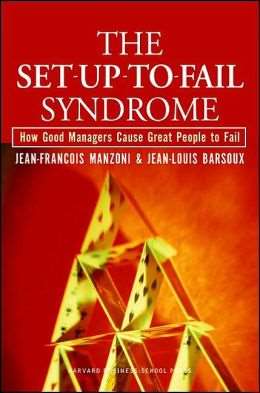
Cover of "The Set-Up-to-Fail Syndrome"The Set-Up-to-Fail Syndrome: How Good Managers Cause Great People to Fail
By Jean-François Manzoni and Jean-Louis Barsoux

If you find yourself spending a lot of time trying to "fix" your relatively weaker performers, then you should definitely read this book.  Manzoni and Barsoux explain how the low expectations managers project onto "perceived weaker performers" tend to become self-fulfilling prophecies.  Includes some great material on how to recognize the syndrome, how to provide feedback more effectively, and how to break out of the set-up-to fail syndrome's downward spiral.  See also the authors' article "Managing Smart" from the Ivey Business Journal Read More...


The Story Factor: Inspiration, Influence, and Persuasion Through the Art of Storytelling
By Annette Simmons

Ray Blunt argues in his article "Leaders and Stories..." that storytelling is a key tool for senior executives to use in developing the next generation of leaders. The Story Factor is a superb manual for anyone who wants to improve their storytelling skills. Simmons explains how stories can be one of the most effective means of influencing people who disagree with you. She also describes the six kinds of stories you should know how to tell and explains a number of storytelling "Do's and Dont's." An exceptionally useful addition to any leader's toolkit. Click here to read a PDF version of Chapter 1. Read More...


Cover of "The Extraordinary Leader"The Extraordinary Leader: Turning Good Managers into Great Leaders
By John H. Zenger and Joseph Folkman

In this extraordinary book, Zenger and Folkman use data from the 360-degree evaluations of over 25,000 leaders to find out what differentiates good leaders from great leaders.  Provides terrific insights about how leveraging certain combinations of strengths can have a profound impact on a leader's effectiveness.   Read more...


Cover of "Primal Leadership"Primal Leadership: Realizing the Power of Emotional Intelligence
By Daniel Goleman, Richard Boyatzis and Annie McKee

Primal Leadership highlights the impact a leader's emotions can have on an organization and the need for leaders to be upbeat and positive.  It also includes the substance of Goleman's well-known article from the Harvard Business Review, "What Makes a Leader?" in which the author explains the importance of mastering various leadership styles and knowing when to use them.  Read more...


Cover of "The Leadership Challenge"The Leadership Challenge
By James M. Kouzes and Barry Z. Posner

In this classic work on leadership, Kouzes and Posner discuss many of the examples of great leadership they have encountered in their nearly 20 years of collaboration and have distilled their findings into a very readable and easy-to-use framework.  Contains many anecdotal examples of great leadership from business, government, and NGOs. Read more...  


Cover of "Accountability"Accountability: Freedom and Responsibility without Control
By Rob Lebow and Randy Spitzer

Accountability is an engaging story of five strangers who meet on a train and have a lively debate about how to improve organizational performance.  The wise older man in the group explains how you can increase accountability in an organization by creating an environment in which employees will take ownership of their jobs. Cites many real-world examples that make a compelling case for the idea that effective and engaged front-line employees make for an effective organization.  This model has been implemented with great success in government organizations such as the Upstate New York Veterans Health Care Network. Read More... 


Cover of "Good to Great"Good to Great: Why Some Companies Make the Leap...and Others Don't
By Jim Collins

Well written and exhaustively researched book about how fairly successful companies made the transition to becoming great companies.  Serves as a "prequel" to Collins' classic book, Built to Last.  Good to Great can be useful to government managers, but especially so for those who are in a position to decide who is--and is not--on their team.  (One of Collins' key findings is that the transition from good to great starts with getting the right people "on the bus" and getting the wrong people "off the bus.") Read more...  


Note: GovLeaders.org accepts no commissions from Amazon.com.  Links to Amazon are provided solely for the convenience of our readers so they can read more reviews--and purchase the books if they so choose.


Next: Books About Management Practices


Copyright © GovLeaders.org 2002-2012


     Home
     About Us

   Look For:
     Articles
     Books
     Blog
     Quotes
     Tools & Tips
     Training

   Learn To:
     Grow Leaders
     Motivate
     Innovate
     Tell Stories
     Lead
     Follow

• Home • About Us • Disclaimer •