
Learning to Lead, Part II
The following article was originally published in The Marine Corps Gazette in December 2001. Reprinted with the kind permission of the author.
MajGen Smith provides an additional 30 common sense leadership tips for Gazette readers.
Part I outlined 30 commonsense tips for good leadership. It has turned out to be the most popular article I have ever written. With the cooperation of the Gazette, I have passed out thousands of copies and tens of thousands have been Xeroxed by various corporations, nonprofits, government, and military organizations as well as a number of professional schools. The following article outlines another 30 tips. I hope they are helpful.
1. Move Your Organization Up the 'Wisdom Pyramid'
If you can assist your organization in moving from a focus on data and
information to a concentration on knowledge, understanding and wisdom,
then better decisions for both the short term and the long term will be
reached.
2. Don't Postpone Joy
If there is something to celebrate, do it now. Don't wait until next
week, next month, or next year to publicly congratulate those who have
just accomplished something extraordinary.
3. Use Your Wit to Amuse, Not Abuse
Laughing at others is hurtful. On the other hand, laughing at yourself
is healing for you and for others. Humor used well is wonderful for you
and those around you. He who laughs, lasts.
4. Polish Your Negotiation Skills
People often ask me, "What is Colin Powell's greatest talent?" I explain
how he brings together people often who are very angry with each other.
By using humor and the spirit of cooperation and compromise, he finds
workable solutions that everyone can support.
5. Beware of Clever, Manipulative Subordinates
This was the major leadership failure at CNN during the nerve gas
debacle in 1998. The chief executive officer not only got snookered by
some clever subordinates, but it also took him much too long to hold a
few top people accountable for their unethical behavior in the
production of CNN's "Valley of Death" special.
6. Don't Neglect the Intangibles
Too many leaders focus all of their attention on what they can
measure-sales numbers, quarterly reports, cash flow, stock price, etc.
These leaders often neglect such vital intangibles as morale and esprit
de corps.
7. Practice Forgiveness
Be willing to forgive those who make honest mistakes. Also, be sure to
forgive yourself after you acknowledge the fact that you have made an
error. Self-flagellation is not a good quality for a leader.
8. Scan the Environment Widely
Too many bosses are unwilling to look outside their own organization for
fresh ideas. For instance, I have learned in the 15 years since I
retired from the military that there is much that corporations can learn
from the military and vice versa.
9. Don't Spend Too Much Time with the Malcontents
It only encourages them. Spend most of your time with those who are
seriously contributing to the accomplishment of the mission.
10. Pick a Positive and a Negative Role Model
My positive role models have been GEN George Marshall and LtCol Jimmie
Dyess, USMCR. Whenever I face a big decision, I ask myself what would
Marshall and Dyess have done in the same situation. Conversely, I use
Robert Strange McNamara as my negative role model. A man who was
arrogant, incompetent as a military strategist, and fundamentally
unethical, McNamara has helped me decide what not to do at many decision
points in my life.
11. Enjoy Your Work and Your People
Working for a boss with a furrowed brow or an angry scowl is no fun nor
does it inspire people to do their very best. If you are obviously
enjoying your work, most people will be captured by your enthusiasm and
joy and will enjoy their work also.
12. Acknowledge Mistakes Quickly and Completely
Be willing to fully air your dirty linen. The best leaders acknowledge
their mistakes quickly and take corrective actions to reduce the
possibility of a similar mistake in the future. Good news may improve
with age, bad news does not.
13. Don't Overconcentrate on the Details
No amount of genius can overcome a preoccupation with detail. This was
the fundamental mistake of the Carter Presidency. A man of compassion
and intellect failed because he was unable to empower subordinates, nor
was he able to think and act strategically.
14. Never Roll the Ball Over
Leaders should remind themselves often that when they play sports, the
object is not to win but to compete with total integrity. Many people
play fast and loose with the game of golf. They cheat, yet they somehow
justify their conduct. (Bill Clinton uses the term "a do over" to
explain the 30 or so mulligans he uses during his golf rounds.)
15. Anticipate Impending Crises
The best leaders have the ability to look around corners and anticipate
problems and impending crises. When you see a crisis headed your way,
take some quick actions to end it and to minimize the damage.
16. Fight the Natural Tendency to Clone Yourself
Although it is very common, it is a terrible mistake to hire people who
look, act, and think like you do. Every time you are about to make a
decision to hire someone, be brutally honest with yourself. Is this person
attractive to you because he or she brings a fresh background,
perspective, or point of view? If not, keep looking. Also, after you hire
someone, force yourself to avoid the tendency to encourage that person to
act and be like you.
17. Welcome Criticism
All leaders should fully understand that criticism and loyalty are
mutually supporting. When subordinates quit complaining that can be very
bad news. It means that they are either afraid to complain or have given
up on making things better within the organization. Both are deadly.
18. Don't Set Unreasonable Deadlines
There is an expression in the Pentagon, "If you want it bad, you will get
it bad." Try to give your folks enough time to put together a solution
that you and they can be proud of.
19. Expect Exceptional Performance
Although perfectionism in a leader can be deadly in any organization,
leaders must not let the pendulum swing too far in the other direction. If
leaders don't ask for exceptional performance from their associates, they
are not likely to get it.
20. Don't Allow Yourself to Become a Wind Chime
If your primary skill is blowing with the wind by being politically agile,
you will not be respected by those you lead. Have a backbone and exercise
your strength of character by taking strong positions on important issues.
21. Focus on Functions, Not on Form
Peter Vaill has pointed out how important it is to be clear on the job to
be done, but to be very flexible on the way to do that job. Leadership is
not a position. It is a process where leadership and followership is a
seamless web. Without followership, leadership always fails. Leaders and
followers determine each others' success. Today you lead, tomorrow you
follow, and vice versa.
22. Fight the Temptation to Get Even
If someone does something to you that is mean spirited, think of it as his
or her problem not your problem. Trying to get even seldom works, lacks
dignity, and makes you look petty and mean spirited. You can never get
ahead by getting even.
23. Focus on Goals Not Process
It is important to be clear about the job to be done but to be very
flexible about the way you do the job.
24. Be a Blame Acceptor
If something goes wrong within the organization that you lead, you must be
willing to accept the blame even though you personally may be only a tiny
part of the failure. Too many bosses try to blame others, especially their
subordinates. By doing so, they often lose the respect of their people and
their bosses.
25. Establish Self-Reinforcing Relationships
Praise and support those who can move smoothly from competition to
cooperation. Encourage those who find solutions that reconcile the
opposites. The French have it right in their national motto - "liberty,
equality, and fraternity."
26. Network Constantly
Every day do some networking, expand your braintrust, seek out creative
and imaginative ideas. Exercise your curiosity and curiosity of your
subordinates.
27. Don't Be a Perfectionist
Leaders tend to drive their associates crazy when they are unwilling to
accept very good but not perfect solutions to tough problems. Leaders must
understand that perfection is seldom possible and that in many cases "the
perfect is the enemy of the good."
28. Find an Anchor and Hold on to It in the Tough Times
I have been blessed with a number of wonderful anchors. My wife of more
than 42 years has lifted me up when I was down and eased me down when I
was sky high. My two adult children have been very helpful, especially
when I was dealing with issues of integrity. A few other close friends
have helped so many times when I was in great need of advice, comfort,
solace, or support.
29. Leverage Opportunities
The best leaders leverage their time, their talents, their technology, and
their friends. In fact, if you use leverage, many things you do will
become easier and quicker. Let me give two personal examples. I am a
terrible typist, but I have a fast computer that allows me to crank out
written material quickly. Also, I am blessed with the talent of speed
reading. It has allowed me to get through my "in-box" quickly and get out
with the troops as well as maintain a regular reading program of about
four books per month.
30. Be a Servant Leader
Too many leaders serve their ambitions or their egos rather than their
people. As I reflect on the marvelous leadership opportunities I have
enjoyed, I realize that I spent most of my time serving the people who
worked for me. Whenever they reached out to me for assistance, I tried to
help them.
A retired major general, Perry M. Smith served for 30 years in the U. S. Air Force. During his career he had a number of leadership experiences, including command of the F-15 wing at Bitburg, Germany where he provided leadership to 4000 personnel. Later, he served as the top Air Force planner and as the Commandant of the National War College, where he taught courses on leadership of large organizations and on strategic planning. He is the author of the book Rules and Tools for Leaders and is currently the President of Visionary Leadership in Augusta, Georgia.
The Marine Corps Gazette ©2001.
More by MagGen Perry Smith
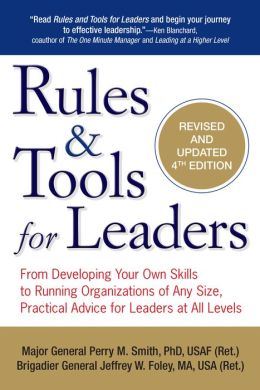
Rules & Tools for Leaders: A Down-to-Earth Guide to Effective Managing
Related Articles
- Quotations from Chairman Powell: A Leadersip Primer
By Oren Harari - Doing a Job (Adm. Hyman Rickover)
Excerpt from a speech by Adm. Hyman Rickover